Shockwave Therapy for Achilles Tendinitis in Chicago
Achilles tendinopathy is a degenerative condition of the Achilles tendon — the thick cord connecting the calf muscles to the heel bone — that causes pain, stiffness, and reduced function, particularly during and after activity. It is one of the most common overuse injuries in runners and active adults, but it also develops in people who have recently increased their activity level or spend long periods on their feet in unsupportive footwear.
Unlike a true Achilles tendon rupture, tendinopathy involves gradual microscopic degeneration of the tendon fibers rather than a sudden tear. Conservative management — eccentric strengthening exercises, load modification, custom orthotics, and physical therapy — is the first-line approach, but a significant subset of patients continue to experience pain and functional limitation despite months of treatment. For these patients, extracorporeal shockwave therapy (ESWT) offers an evidence-backed non-surgical option that directly targets the degenerative tissue and stimulates genuine repair at the cellular level.
At Michigan Avenue Podiatry, Dr. Mohammad Usman, DPM performs ESWT for Achilles tendinopathy at our Chicago office. Dr. Usman uses diagnostic ultrasound to characterize the extent and location of tendon degeneration before designing each patient’s treatment protocol. ESWT for Achilles tendinitis is offered as a cash-pay procedure. Call (312) 701-0770 to discuss whether ESWT is right for your Achilles condition.
Schedule an Achilles Tendinitis Consultation
Dr. Mohammad Usman, DPM offers ESWT for Achilles tendinopathy at our Chicago office. Cash-pay procedure — evidence-based, non-surgical.
Book a ConsultationCall (312) 701-0770ESWT Evidence for Achilles Tendinopathy
The clinical evidence supporting ESWT for Achilles tendinopathy is substantial and consistent across multiple study designs. A 2023 systematic review and meta-analysis found ESWT effective for both Achilles tendinopathy and plantar fasciitis, with good outcomes demonstrated across randomized controlled trials, prospective cohort studies, and long-term follow-up assessments (PubMed 37662911).
A 2020 RCT published in the British Journal of Sports Medicine found that ESWT combined with eccentric exercises produced significantly better outcomes than eccentric exercises alone for chronic Achilles tendinopathy, with a 75% success rate in the combination group versus 57% in the exercise-only group at 12-week follow-up. A 2021 systematic review of 17 randomized controlled trials confirmed ESWT as an effective standalone or adjunctive treatment for chronic Achilles tendinopathy, with an overall response rate of approximately 70–80% in patients who had failed 3 months of conservative management.
A comprehensive 2024 meta-analysis of 45 controlled studies across tendinopathy conditions found significant pain reduction with ESWT as a class of treatment (PMC11041007), with Achilles tendinopathy among the conditions demonstrating consistent, durable response.
How ESWT Repairs Achilles Tendon Tissue
The mechanism of ESWT in Achilles tendinopathy is well understood at the tissue and cellular level. Chronic Achilles tendinopathy involves tendinosis — degenerative change characterized by disorganized collagen architecture, neovascularization of pathological vessels (Koos pattern), tenocyte apoptosis, and mucoid degeneration within the tendon substance. This is a fundamentally different pathological process from acute inflammation, which is why anti-inflammatory approaches alone often fail for chronic tendinopathy.
Shockwave energy delivered to the degenerative tendon tissue stimulates a multi-stage healing response:
- Neovascularization: Formation of new, functional blood vessels restores nutrient and oxygen delivery to the chronically hypovascular degenerated tissue
- Growth factor release: Upregulation of TGF-β1, VEGF, IGF-1, and PDGF activates tenocyte proliferation and new collagen matrix synthesis
- Neocollagenesis: Synthesis of organized type I collagen fibers to replace the disorganized, degraded tendon matrix
- Substance P depletion: Reduction of substance P in local sensory nerve fibers provides direct analgesic effects and interrupts the chronic pain cycle
- Mechanotransduction: Acoustic mechanical stimulation directly activates mechanoreceptors on tenocytes, driving a gene expression profile associated with tendon repair
The result is actual tissue-level repair — not temporary pain suppression — which explains why ESWT produces outcomes that continue to improve over weeks to months and are more durable than injection therapy at long-term follow-up.
Is ESWT Right for Your Achilles Tendon?
Dr. Mohammad Usman, DPM reviews your diagnostic imaging and history before recommending shockwave therapy. Contact us to schedule your evaluation.
Book a ConsultationCall (312) 701-0770Insertional vs. Non-Insertional Achilles Tendinopathy
Achilles tendinopathy occurs in two anatomically distinct locations, each with different biomechanical causes and treatment considerations. Understanding the distinction is important because the applicator placement and treatment parameters for ESWT are adjusted based on which type is present.
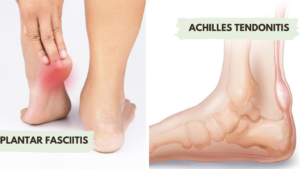
Insertional Achilles tendinopathy affects the point where the tendon attaches to the posterior heel bone (calcaneus). Pain is localized to the back of the heel at the tendon’s insertion, often with bony enlargement (Haglund’s deformity) or calcium deposits visible on X-ray. It is more common in recreational runners, people with a high arch (cavus) foot type, and older adults. It tends to be more resistant to conservative treatment than non-insertional disease.
Non-insertional Achilles tendinopathy affects the mid-portion of the tendon, typically 2–6 cm above the insertion. It is more commonly associated with overuse in distance runners and is characterized by a fusiform (spindle-shaped) thickening of the tendon at the affected zone on ultrasound. ESWT is effective for both forms, with Dr. Usman adjusting probe placement to target the specific location of degeneration identified on ultrasound imaging at the pre-treatment evaluation.
The ESWT Treatment Protocol for Achilles Tendinitis
A standard ESWT course for Achilles tendinopathy consists of 3–5 sessions spaced one week apart. During each session, ultrasound gel is applied to the posterior heel and lower leg, and the shockwave applicator is placed along the tendon — at the insertion point for insertional type, or along the mid-tendon for non-insertional type.
Patients typically experience mild to moderate discomfort during treatment at the most degenerated portion of the tendon — a clinically useful signal confirming the waves are reaching the target tissue. Sessions last 15–20 minutes with no anesthesia required. There is no post-treatment downtime: patients can resume normal walking and low-impact activity immediately. High-impact training and prolonged running are best avoided for 24–48 hours after each session to allow the healing response to proceed.
Between sessions, activity modification is recommended but complete rest is generally not required — in fact, some degree of tendon loading helps drive the tissue remodeling process. Some ESWT protocols for Achilles tendinopathy combine shockwave treatment with structured eccentric strengthening exercises (Alfredson protocol), which may improve outcomes compared to either treatment alone. Dr. Usman will advise on the appropriate adjunctive exercise approach based on your specific presentation.
Improvement typically begins within 4–6 weeks of completing the treatment course. Full tendon remodeling and peak clinical benefit continue to develop over 3–6 months following the final ESWT session, reflecting the time required for organized collagen synthesis and tendon structural reorganization.
Shockwave Therapy for Achilles Tendinitis at Michigan Avenue Podiatry
Michigan Avenue Podiatry offers ESWT for Achilles tendinopathy at our Chicago office at 30 North Michigan Avenue, Suite 1220. Dr. Mohammad Usman, DPM performs a complete evaluation including clinical examination and diagnostic ultrasound to characterize the location and extent of tendon degeneration before treatment is planned. This imaging-guided approach ensures the shockwave protocol is accurately targeted to the affected tendon zone.
ESWT is offered as a cash-pay procedure at our practice. This is a procedure Dr. Usman performs entirely in-office — no hospital, no anesthesia, no surgical facility. Contact us to discuss pricing during your consultation. Call (312) 701-0770 or book online. For a full overview of shockwave therapy at MAP, see our shockwave treatment hub page.
Book Your Achilles Tendinitis Consultation
Dr. Mohammad Usman, DPM treats Achilles tendinopathy with ESWT at our Chicago office. Cash-pay — contact us to discuss pricing and next steps.
Book a ConsultationCall (312) 701-0770Frequently Asked Questions
Can I run while undergoing shockwave therapy for Achilles tendinitis?
Light running and low-impact activity are generally permitted between sessions, but high-intensity training should be reduced. Dr. Usman will provide specific guidance based on your tendon’s response and imaging findings. Some load on the tendon between sessions is actually beneficial for driving the remodeling process.
How long does it take to see results from ESWT for Achilles tendinitis?
Many patients notice improved function and reduced pain within 4–6 weeks of completing their treatment course. Full tendon remodeling and peak benefit can take 3–6 months, as organized collagen synthesis is a gradual biological process. Clinical studies show outcomes continuing to improve through 6-month follow-up assessments.
What if I’ve already tried physical therapy for Achilles tendinitis?
ESWT is often recommended precisely when physical therapy and eccentric exercises alone have been insufficient — the shockwave energy directly addresses the tendinopathic tissue that exercise cannot adequately stimulate to repair. Some protocols combine ESWT with continued structured loading exercises for better outcomes than either treatment alone.
What is the difference between insertional and non-insertional Achilles tendinopathy for ESWT?
Both types respond to ESWT, but the probe placement and energy parameters are adjusted based on the location of degeneration identified on diagnostic ultrasound. Insertional tendinopathy targets the heel bone attachment; non-insertional targets the mid-tendon zone 2–6 cm above the heel. Dr. Usman performs diagnostic ultrasound before treatment to precisely map the affected area.
How much does shockwave therapy for Achilles tendinitis cost?
ESWT is a cash-pay procedure at Michigan Avenue Podiatry. Pricing is discussed in full during your initial consultation with Dr. Usman before any treatment is scheduled. Call (312) 701-0770 to learn more. The cost covers a complete treatment course — typically 3–5 sessions.